Copyright © 2025 Chuangming Coupling (Jiangsu) Co.,Ltd.
The functions and characteristics of the jaw coupling
2026-03-13
Jaw couplings are mainly manufactured through processing methods such as turning, milling, and broaching, followed by overall heat treatment to ensure sufficient mechanical strength. Next, let us introduce the functional characteristics of the jaw coupling.
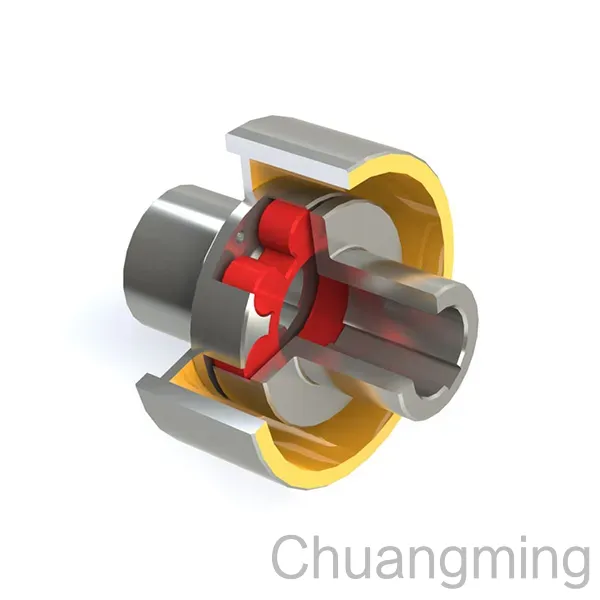
The jaw coupling features excellent balancing performance and is suitable for high speed applications (up to 30,000 rpm). However, it cannot accommodate large misalignments, particularly axial misalignment. Large eccentricity and angular deflection can result in higher bearing loads compared to other servo couplings.
Another important concern is the failure behavior of the jaw coupling. Once the elastic spider becomes damaged or fails, torque transmission is not interrupted; instead, the metal jaws of the two hubs engage and continue to transmit torque, which may potentially cause problems in the system. Selecting the appropriate material for the elastic spider according to the actual application is a major advantage of this coupling. Some automation equipment suppliers offer spiders with various elastic materials, different hardness levels, and temperature resistances, allowing customers to choose the right material to meet the performance requirements of their applications.
The elastic body of a jaw coupling is generally made of engineering plastic or rubber. The service life of the coupling is equivalent to that of the elastic body. Since the elastic body is primarily subjected to compression rather than tension, its service life is typically 10 years. Thanks to its buffering and vibration damping properties, it is widely used in applications with strong vibrations. The operating temperature range of the coupling is determined by the temperature limit of the elastic body, usually from -35°C to +80°C.
Jaw couplings are mainly manufactured through processing methods such as turning, milling, and broaching, followed by overall heat treatment to ensure sufficient mechanical strength. Next, let us introduce the functional characteristics of the jaw coupling.
The jaw coupling features excellent balancing performance and is suitable for high speed applications (up to 30,000 rpm). However, it cannot accommodate large misalignments, particularly axial misalignment. Large eccentricity and angular deflection can result in higher bearing loads compared to other servo couplings.
Another important concern is the failure behavior of the jaw coupling. Once the elastic spider becomes damaged or fails, torque transmission is not interrupted; instead, the metal jaws of the two hubs engage and continue to transmit torque, which may potentially cause problems in the system. Selecting the appropriate material for the elastic spider according to the actual application is a major advantage of this coupling. Some automation equipment suppliers offer spiders with various elastic materials, different hardness levels, and temperature resistances, allowing customers to choose the right material to meet the performance requirements of their applications.
The elastic body of a jaw coupling is generally made of engineering plastic or rubber. The service life of the coupling is equivalent to that of the elastic body. Since the elastic body is primarily subjected to compression rather than tension, its service life is typically 10 years. Thanks to its buffering and vibration damping properties, it is widely used in applications with strong vibrations. The operating temperature range of the coupling is determined by the temperature limit of the elastic body, usually from -35°C to +80°C.