Copyright © 2025 Chuangming Coupling (Jiangsu) Co.,Ltd.
Brake Pulley of Coupling
2025-12-06
In the transmission systems of heavy-duty industrial equipment, the coupling brake wheel serves as a core component that combines the functions of a "power link" and a "safety valve", and is commonly used in scenarios such as mine hoists, port cranes, and ship propulsion systems. It is a crucial element for ensuring the efficient operation and safe start-stop of the equipment.
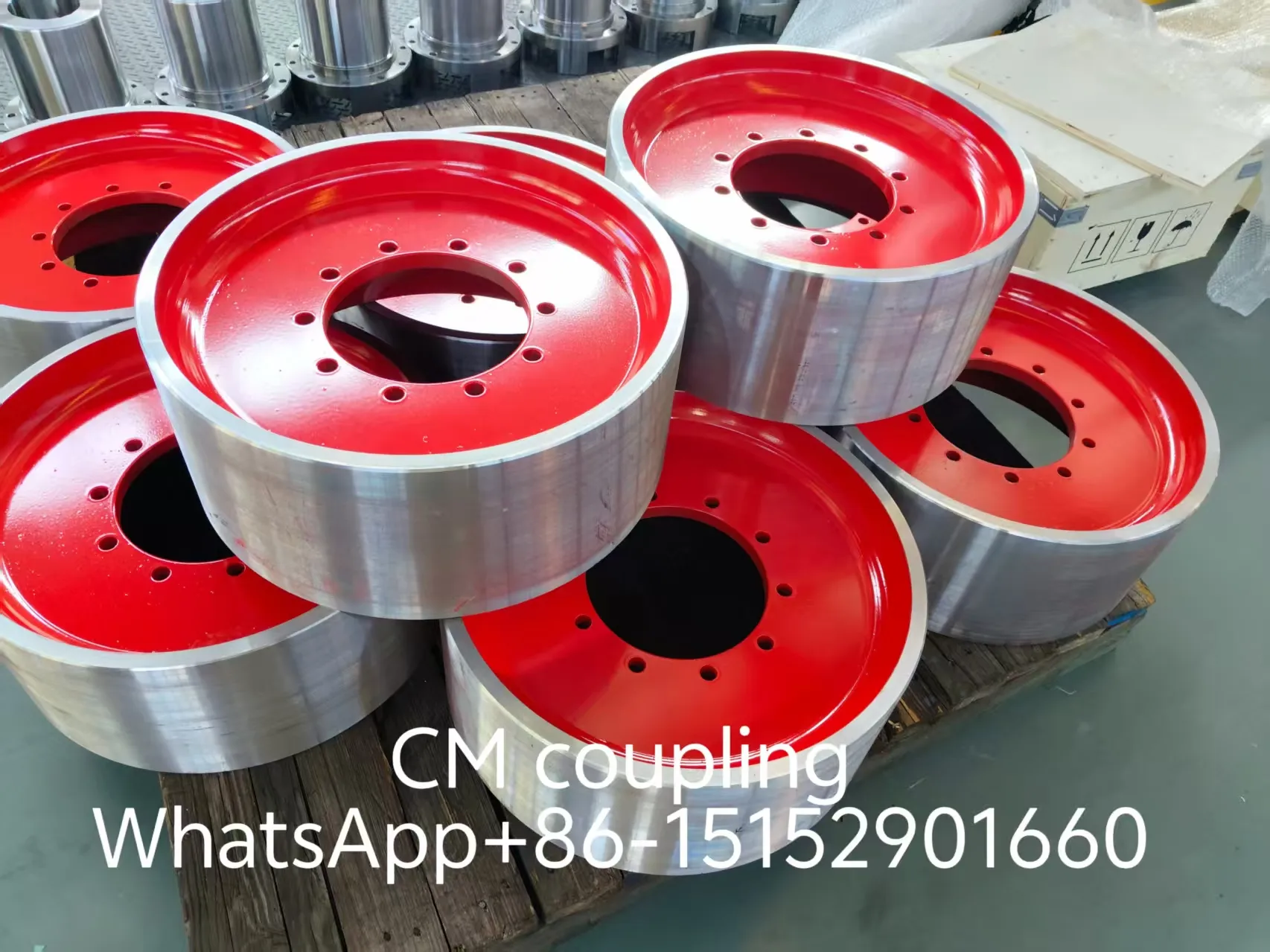
Structurally, a coupling brake wheel typically consists of a metal wheel body, a connecting flange, and a braking friction surface. The wheel body is often made of high-strength cast steel or alloy forgings to ensure resistance to impact and fatigue under heavy loads. The friction surface undergoes heat treatment processes such as quenching and carburizing to enhance wear resistance and heat resistance. The bolt holes at the flange are used for precise alignment with the drive shaft and braking device. The red coating on the "CM coupling" type brake wheel in the picture not only provides rust protection but also facilitates quick identification and maintenance in industrial environments.
The core value of the coupling brake wheel lies in its dual functions: on one hand, it transmits power by smoothly transferring the torque from the motor or engine to the working mechanism through the coupling structure, while also buffering vibrations and shocks during operation to reduce wear on equipment components. On the other hand, it provides safety braking. When the equipment needs to be slowed down or stopped urgently, the brake caliper and the friction surface work together to convert kinetic energy into heat energy for rapid dissipation, preventing mechanical overload and loss of control. For instance, in the operation of mine hoists, the response speed of the brake wheel directly affects the safety of lifting heavy objects, and its failure could lead to a falling object accident.
When selecting a coupling brake wheel, three key parameters should be focused on: torque carrying capacity (which should match the equipment power), heat resistance limit (to cope with the high temperatures generated during continuous braking), and concentricity accuracy (to avoid abnormal wear caused by eccentric operation). During daily maintenance, it is necessary to regularly check the wear of the friction surface, the tightness of the bolts, and clean the surface oil stains (as oil stains can reduce braking friction). This ensures its long-term stable operation.
With the development of industrial intelligence, new types of coupling brake wheels are beginning to integrate temperature and wear sensors, enabling real-time monitoring of operating conditions and predictive maintenance. This seemingly simple component is not only a "connector" for efficient industrial transmission but also a "guardian" of production safety, making it an indispensable core component in heavy-duty equipment.
In the transmission systems of heavy-duty industrial equipment, the coupling brake wheel serves as a core component that combines the functions of a "power link" and a "safety valve", and is commonly used in scenarios such as mine hoists, port cranes, and ship propulsion systems. It is a crucial element for ensuring the efficient operation and safe start-stop of the equipment.
Structurally, a coupling brake wheel typically consists of a metal wheel body, a connecting flange, and a braking friction surface. The wheel body is often made of high-strength cast steel or alloy forgings to ensure resistance to impact and fatigue under heavy loads. The friction surface undergoes heat treatment processes such as quenching and carburizing to enhance wear resistance and heat resistance. The bolt holes at the flange are used for precise alignment with the drive shaft and braking device. The red coating on the "CM coupling" type brake wheel in the picture not only provides rust protection but also facilitates quick identification and maintenance in industrial environments.
The core value of the coupling brake wheel lies in its dual functions: on one hand, it transmits power by smoothly transferring the torque from the motor or engine to the working mechanism through the coupling structure, while also buffering vibrations and shocks during operation to reduce wear on equipment components. On the other hand, it provides safety braking. When the equipment needs to be slowed down or stopped urgently, the brake caliper and the friction surface work together to convert kinetic energy into heat energy for rapid dissipation, preventing mechanical overload and loss of control. For instance, in the operation of mine hoists, the response speed of the brake wheel directly affects the safety of lifting heavy objects, and its failure could lead to a falling object accident.
When selecting a coupling brake wheel, three key parameters should be focused on: torque carrying capacity (which should match the equipment power), heat resistance limit (to cope with the high temperatures generated during continuous braking), and concentricity accuracy (to avoid abnormal wear caused by eccentric operation). During daily maintenance, it is necessary to regularly check the wear of the friction surface, the tightness of the bolts, and clean the surface oil stains (as oil stains can reduce braking friction). This ensures its long-term stable operation.
With the development of industrial intelligence, new types of coupling brake wheels are beginning to integrate temperature and wear sensors, enabling real-time monitoring of operating conditions and predictive maintenance. This seemingly simple component is not only a "connector" for efficient industrial transmission but also a "guardian" of production safety, making it an indispensable core component in heavy-duty equipment.