Copyright © 2025 Chuangming Coupling (Jiangsu) Co.,Ltd.
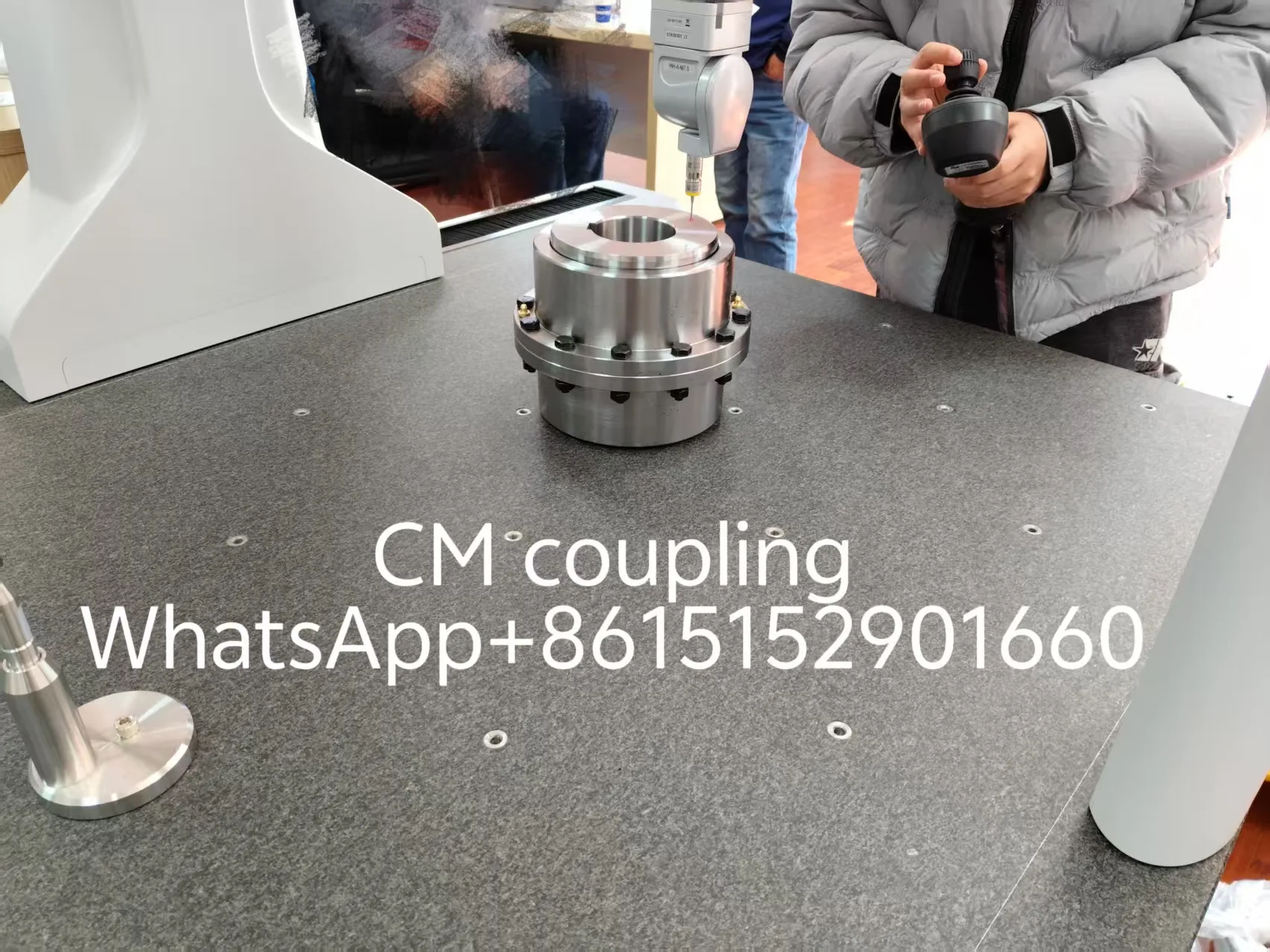
The coupling undergoes three-dimensional coordinate measurement
2025-11-28
In the field of precision machinery, a "difference of a hair's breadth" often determines the reliability and lifespan of a product - this is precisely the quality standard that we always adhere to for the CM coupling.
When this metallic-looking CM coupling is placed steadily on the three-coordinate inspection table, the probe of the high-precision measuring instrument is ready to "examine" every detail of it: from the concentricity of the shaft hole to the flatness of the flange surface, from the positional tolerance of the bolt holes to the overall form and position accuracy, the micrometer-level detection accuracy makes any minor flaws impossible to hide. This is not "making a fuss over nothing", but our basic requirement for product quality - as the core component of the transmission system, the accuracy of the coupling directly affects the stability of the equipment operation, and there can be no compromise.
A perfect detection system is the cornerstone of our quality confidence. Besides the three-coordinate measuring instrument, the hardness tester, the dynamic balance machine, the torque testing table and other equipment in the workshop have built a full-process inspection network from raw materials to finished products: raw materials entering the factory need to pass component and mechanical property inspections, each process in the processing is equipped with dedicated inspection tools, and the finished products need to undergo multiple rounds of verification such as assembly simulation and load testing. Just like this CM coupling, from the raw material to the finished product, it needs to pass more than ten inspection checkpoints to ensure that every delivered product meets or even exceeds industry standards.
For us, "high quality" has never been just a slogan; it is an action logic running through the entire production chain: when the light of the inspection equipment sweeps over the surface of the coupling, every movement of the probe corresponds to precise data recording, we know that this rigor is both responsible for the safety of the customer's equipment and the protection of our own brand reputation. After all, on the track of precision manufacturing, only by polishing the product with an "meticulous attention to detail" attitude can one stand firm in the market - and this is our unwavering persistence.
In the field of precision machinery, a "difference of a hair's breadth" often determines the reliability and lifespan of a product - this is precisely the quality standard that we always adhere to for the CM coupling.
When this metallic-looking CM coupling is placed steadily on the three-coordinate inspection table, the probe of the high-precision measuring instrument is ready to "examine" every detail of it: from the concentricity of the shaft hole to the flatness of the flange surface, from the positional tolerance of the bolt holes to the overall form and position accuracy, the micrometer-level detection accuracy makes any minor flaws impossible to hide. This is not "making a fuss over nothing", but our basic requirement for product quality - as the core component of the transmission system, the accuracy of the coupling directly affects the stability of the equipment operation, and there can be no compromise.
A perfect detection system is the cornerstone of our quality confidence. Besides the three-coordinate measuring instrument, the hardness tester, the dynamic balance machine, the torque testing table and other equipment in the workshop have built a full-process inspection network from raw materials to finished products: raw materials entering the factory need to pass component and mechanical property inspections, each process in the processing is equipped with dedicated inspection tools, and the finished products need to undergo multiple rounds of verification such as assembly simulation and load testing. Just like this CM coupling, from the raw material to the finished product, it needs to pass more than ten inspection checkpoints to ensure that every delivered product meets or even exceeds industry standards.
For us, "high quality" has never been just a slogan; it is an action logic running through the entire production chain: when the light of the inspection equipment sweeps over the surface of the coupling, every movement of the probe corresponds to precise data recording, we know that this rigor is both responsible for the safety of the customer's equipment and the protection of our own brand reputation. After all, on the track of precision manufacturing, only by polishing the product with an "meticulous attention to detail" attitude can one stand firm in the market - and this is our unwavering persistence.
Previous: Brake Pulley of Coupling