Copyright © 2025 Chuangming Coupling (Jiangsu) Co.,Ltd.
Ball Cage Couplings: The 'Precision Joints' in Industrial Transmission
2025-12-12
In automotive steering systems and the power chains of mining machinery, there is a component capable of "flexible power transmission" - the ball cage coupling. It is a core element for achieving stable transmission between different shaft systems.
The core structure of a ball cage coupling consists of an outer ball track ring, a star-shaped inner hub, power transmission steel balls, and a cage. The outer ball track ring and the inner hub are respectively connected to the driving and driven shafts. Six to eight steel balls are held in place by the cage and embedded in the precise raceways of both. The secret to its constant velocity transmission lies in the fact that the steel balls are always located on the bisector plane of the angle between the two shafts. Regardless of how the shaft angle changes, the positional difference of the power transmission points is offset by the raceway constraints, thus achieving synchronous transmission with an instantaneous angular velocity error of the driving and driven shafts ≤ 0.1%, completely solving the speed fluctuation problem of traditional universal joints.
This structure endows it with three core advantages: First, it has strong load-bearing and compensation capabilities - under the same size, its load-bearing capacity is 0.5 to 1 times higher than that of traditional couplings, and it can operate stably under an angle of up to 42°between the shafts, while also accommodating installation deviations in both axial and radial directions. Second, it has low loss and a long service life - the rolling of steel balls replaces sliding friction, with a transmission efficiency of ≥ 98%. Combined with a sealing structure and special lubricating grease, it can achieve "lifelong maintenance-free". Third, it can adapt to complex working conditions - made of 42CrMo alloy steel and treated with carburizing and quenching, it can withstand temperature fluctuations from -40°C to 350°C and resist dust, corrosion, and other harsh environments.
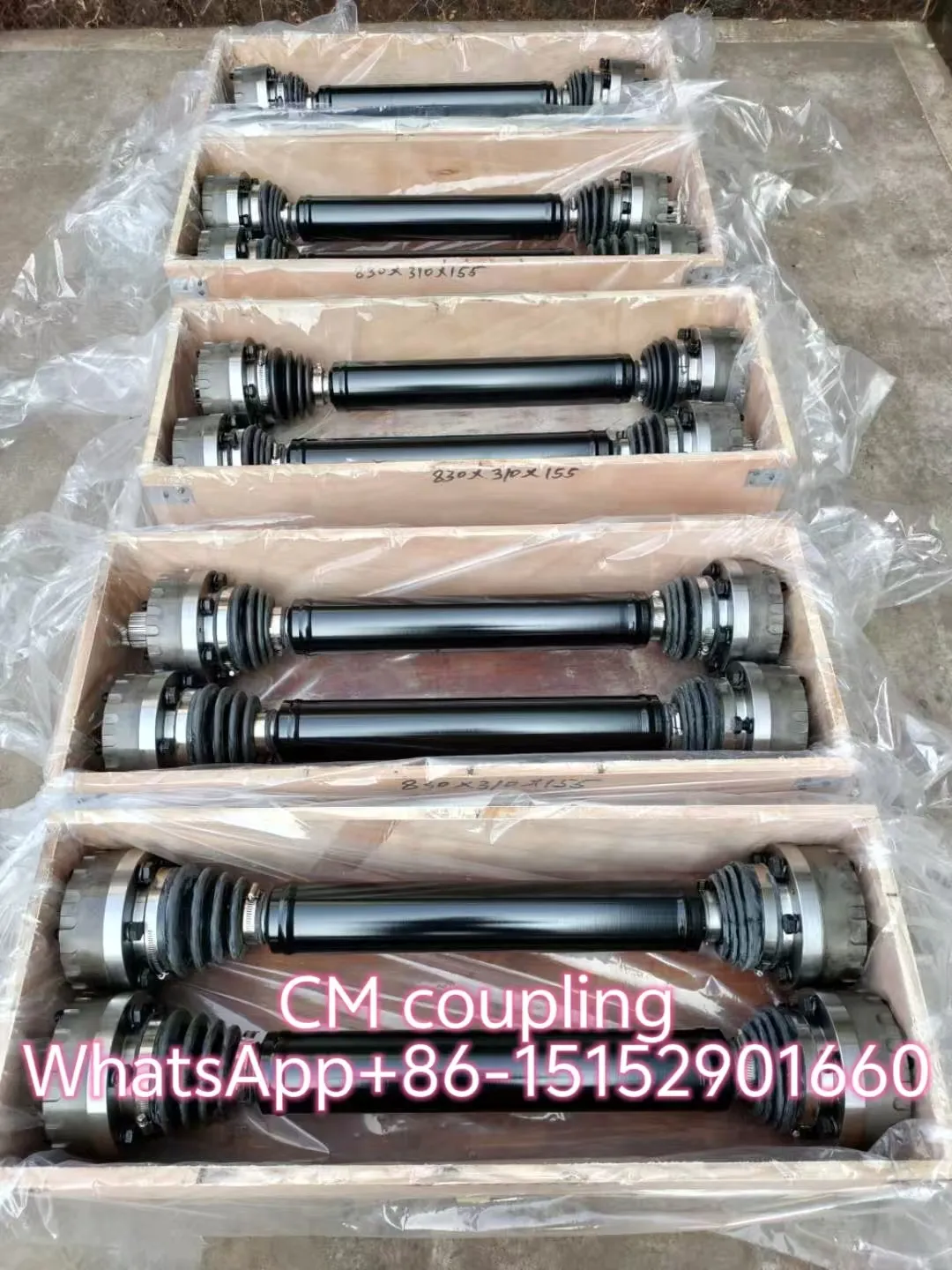
From the perspective of application scenarios, it is a standard component in automotive steering drive axles, ensuring the power synchronization during wheel steering. In metallurgical rolling mills and mining crushers, it can bear instantaneous impact torques and compensate for installation errors of equipment. Even in precision radars and heavy-duty machine tools, its ±0.1°level transmission accuracy can meet the high requirements of motion control.
As a "precision joint" in industrial transmission, the ball cage coupling balances flexibility and stability with its precise structure, becoming a key supporting component for modern equipment to develop towards high efficiency, heavy load, and precision.
In automotive steering systems and the power chains of mining machinery, there is a component capable of "flexible power transmission" - the ball cage coupling. It is a core element for achieving stable transmission between different shaft systems.
The core structure of a ball cage coupling consists of an outer ball track ring, a star-shaped inner hub, power transmission steel balls, and a cage. The outer ball track ring and the inner hub are respectively connected to the driving and driven shafts. Six to eight steel balls are held in place by the cage and embedded in the precise raceways of both. The secret to its constant velocity transmission lies in the fact that the steel balls are always located on the bisector plane of the angle between the two shafts. Regardless of how the shaft angle changes, the positional difference of the power transmission points is offset by the raceway constraints, thus achieving synchronous transmission with an instantaneous angular velocity error of the driving and driven shafts ≤ 0.1%, completely solving the speed fluctuation problem of traditional universal joints.
This structure endows it with three core advantages: First, it has strong load-bearing and compensation capabilities - under the same size, its load-bearing capacity is 0.5 to 1 times higher than that of traditional couplings, and it can operate stably under an angle of up to 42°between the shafts, while also accommodating installation deviations in both axial and radial directions. Second, it has low loss and a long service life - the rolling of steel balls replaces sliding friction, with a transmission efficiency of ≥ 98%. Combined with a sealing structure and special lubricating grease, it can achieve "lifelong maintenance-free". Third, it can adapt to complex working conditions - made of 42CrMo alloy steel and treated with carburizing and quenching, it can withstand temperature fluctuations from -40°C to 350°C and resist dust, corrosion, and other harsh environments.
From the perspective of application scenarios, it is a standard component in automotive steering drive axles, ensuring the power synchronization during wheel steering. In metallurgical rolling mills and mining crushers, it can bear instantaneous impact torques and compensate for installation errors of equipment. Even in precision radars and heavy-duty machine tools, its ±0.1°level transmission accuracy can meet the high requirements of motion control.
As a "precision joint" in industrial transmission, the ball cage coupling balances flexibility and stability with its precise structure, becoming a key supporting component for modern equipment to develop towards high efficiency, heavy load, and precision.