Copyright © 2025 Chuangming Coupling (Jiangsu) Co.,Ltd.
Universal joints enable the continuous rotation of the two connected shafts
2026-06-12
Universal joints share the common feature of a large angular compensation capacity, with different structural types allowing varying angles between the two shaft axes. By utilizing their unique mechanical design, universal joints enable continuous rotation of connected shafts even when they are not aligned and have an angular offset, reliably transmitting torque and motion. The most notable characteristics of universal joints include high angular compensation capability, compact structure, and high transmission efficiency.
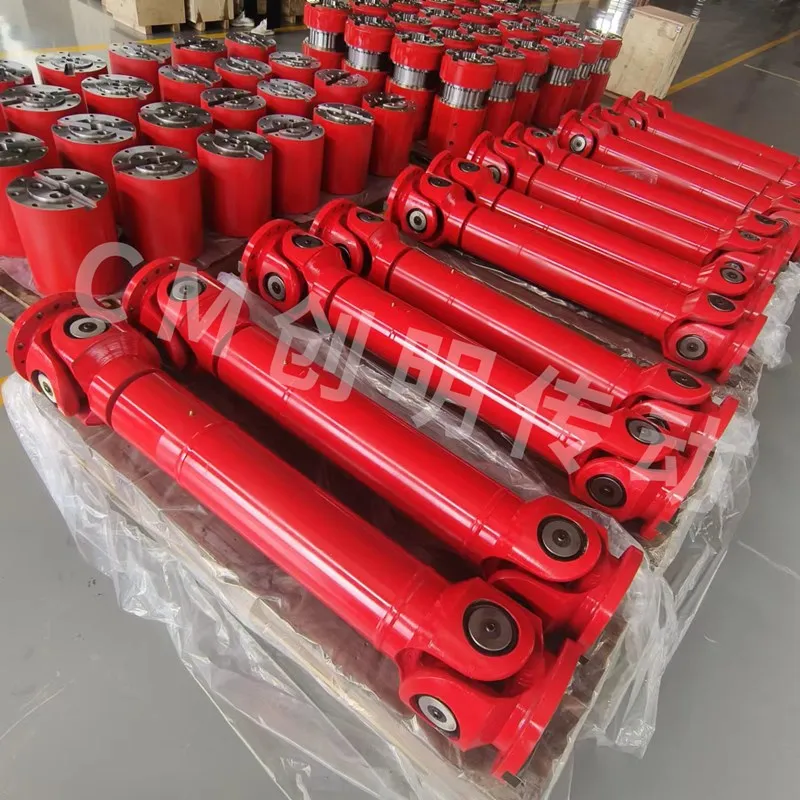
In practical applications, they are classified into heavy-duty, medium-duty, light-duty, and small types based on the transmitted torque. Universal joints come pre-filled with sufficient lubricating grease and do not require additional oiling during operation. However, if stored for more than six months, re-lubrication is necessary before installation. Adequate lubrication is essential: during initial operation, bearings should be lubricated weekly until running normally; thereafter, lubrication should occur quarterly. For spline pairs, lubrication should be performed every six months.
When replenishing grease to the bearings, new grease should displace the old grease through the seal until fresh grease begins to overflow. In high-speed, heavy-load power transmission systems, some couplings also serve as buffers, dampen vibrations, and improve the dynamic performance of the shaft system. A universal joint consists of two halves, each connected to the driving and driven shafts respectively. Most power machines are typically connected to working machinery via couplings.
Each section allows a maximum rotational angle of 45 degrees and accommodates relatively large shaft spacing. Keyways, square holes, or hexagonal holes can be machined according to requirements. The angle between the two shafts may vary within specified limits as needed. Cross-axis type universal joints are commonly used in mechanical shaft systems across industries such as metallurgy, lifting, engineering transportation, mining, petroleum, shipbuilding, coal, rubber, papermaking, and other heavy machinery sectors to transmit torque.
Universal joints share the common feature of a large angular compensation capacity, with different structural types allowing varying angles between the two shaft axes. By utilizing their unique mechanical design, universal joints enable continuous rotation of connected shafts even when they are not aligned and have an angular offset, reliably transmitting torque and motion. The most notable characteristics of universal joints include high angular compensation capability, compact structure, and high transmission efficiency.
In practical applications, they are classified into heavy-duty, medium-duty, light-duty, and small types based on the transmitted torque. Universal joints come pre-filled with sufficient lubricating grease and do not require additional oiling during operation. However, if stored for more than six months, re-lubrication is necessary before installation. Adequate lubrication is essential: during initial operation, bearings should be lubricated weekly until running normally; thereafter, lubrication should occur quarterly. For spline pairs, lubrication should be performed every six months.
When replenishing grease to the bearings, new grease should displace the old grease through the seal until fresh grease begins to overflow. In high-speed, heavy-load power transmission systems, some couplings also serve as buffers, dampen vibrations, and improve the dynamic performance of the shaft system. A universal joint consists of two halves, each connected to the driving and driven shafts respectively. Most power machines are typically connected to working machinery via couplings.
Each section allows a maximum rotational angle of 45 degrees and accommodates relatively large shaft spacing. Keyways, square holes, or hexagonal holes can be machined according to requirements. The angle between the two shafts may vary within specified limits as needed. Cross-axis type universal joints are commonly used in mechanical shaft systems across industries such as metallurgy, lifting, engineering transportation, mining, petroleum, shipbuilding, coal, rubber, papermaking, and other heavy machinery sectors to transmit torque.
Previous: No more data