Copyright © 2025 Chuangming Coupling (Jiangsu) Co.,Ltd.
Pin-type couplings may experience bent pins due to equipment overload operation.
2026-05-29
Excessive or uneven tightening force on the pin bolts can over-compress the elastic rings, causing pin misalignment and deformation of the elastic rings, resulting in uneven stress distribution and equipment vibration. Pin-type couplings rely on the deformation of elastic elements to compensate for relative shaft displacement, offering excellent performance in offset compensation, vibration damping, and shock absorption. Therefore, they are suitable for applications involving frequent reversal, frequent starts, high speeds, or impact loads.
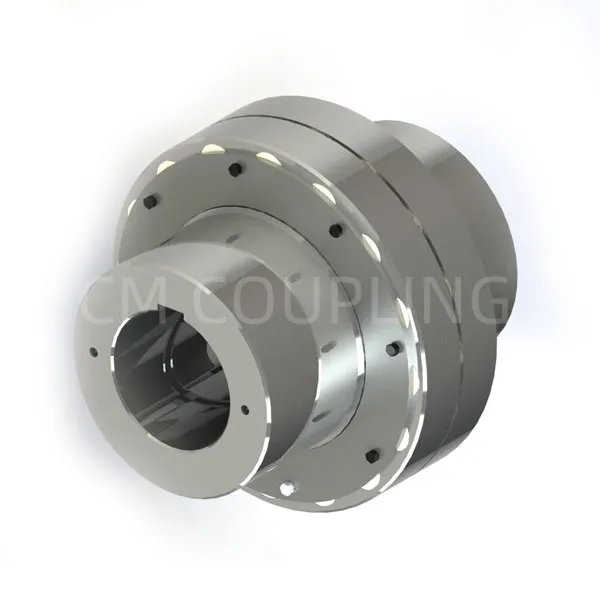
As a method of torque transmission, the operating condition of pin-type couplings is crucial to the performance of rotating equipment, yet they are often overlooked during maintenance. During torque transmission, under various internal and external stresses, as well as improper operation or maintenance practices, various defects or damage may occur. Several commonly neglected issues include:
Inconsistent inner and outer diameters of elastic rings—either between new and old rings or within individual rings—can lead to uneven loading inside the pin holes. This causes irregular torque transmission during operation, resulting in equipment vibration. If the outer diameter of the elastic ring is manufactured too large, it fits too tightly into the pin hole, often requiring forced hammering during assembly. Such conditions prevent the elastic ring from compensating for minor axial misalignment of the drive shaft and instead disrupt shaft alignment, inducing vibration.
Severe wear or spalling on the locating conical surface or cone hole of the pin leads to inaccurate pin positioning and pin skewing, causing uneven load distribution around the circumference and resulting in equipment vibration. Elastic rings are prone to wear, especially severe uneven wear; when reassembled, this leads to unbalanced forces and vibration. Overloading of the equipment can bend the pins, and upon reinstallation, the skewed pins cause uneven circumferential loading on the coupling, triggering equipment vibration.
Excessive or uneven tightening force on the pin bolts can over-compress the elastic rings, causing pin misalignment and deformation of the elastic rings, resulting in uneven stress distribution and equipment vibration. Pin-type couplings rely on the deformation of elastic elements to compensate for relative shaft displacement, offering excellent performance in offset compensation, vibration damping, and shock absorption. Therefore, they are suitable for applications involving frequent reversal, frequent starts, high speeds, or impact loads.
As a method of torque transmission, the operating condition of pin-type couplings is crucial to the performance of rotating equipment, yet they are often overlooked during maintenance. During torque transmission, under various internal and external stresses, as well as improper operation or maintenance practices, various defects or damage may occur. Several commonly neglected issues include:
Inconsistent inner and outer diameters of elastic rings—either between new and old rings or within individual rings—can lead to uneven loading inside the pin holes. This causes irregular torque transmission during operation, resulting in equipment vibration. If the outer diameter of the elastic ring is manufactured too large, it fits too tightly into the pin hole, often requiring forced hammering during assembly. Such conditions prevent the elastic ring from compensating for minor axial misalignment of the drive shaft and instead disrupt shaft alignment, inducing vibration.
Severe wear or spalling on the locating conical surface or cone hole of the pin leads to inaccurate pin positioning and pin skewing, causing uneven load distribution around the circumference and resulting in equipment vibration. Elastic rings are prone to wear, especially severe uneven wear; when reassembled, this leads to unbalanced forces and vibration. Overloading of the equipment can bend the pins, and upon reinstallation, the skewed pins cause uneven circumferential loading on the coupling, triggering equipment vibration.