Copyright © 2025 Chuangming Coupling (Jiangsu) Co.,Ltd.
Limitations of couplings in compensating for misalignment between shafts
2026-09-11
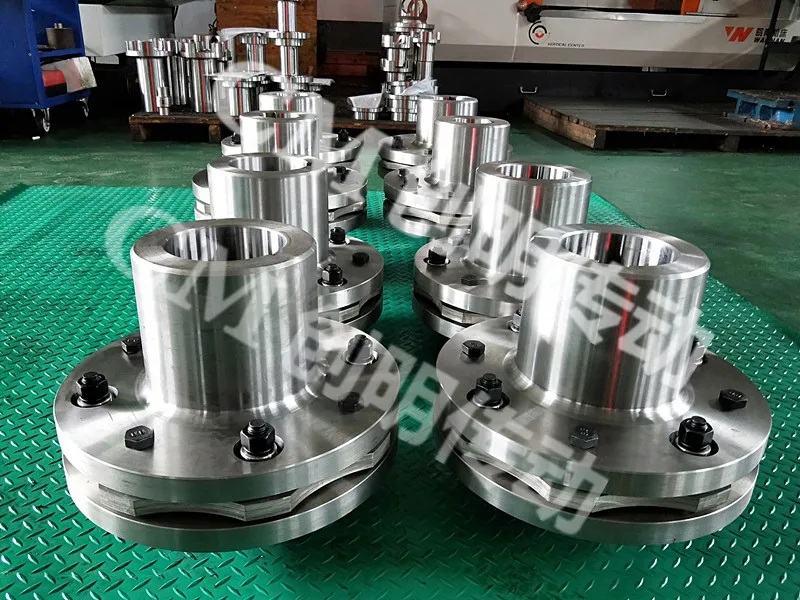
Couplings have mounting flanges or corresponding connection structures at both ends, commonly used to connect driving shafts and driven shafts, or driving shafts and rotating components, transmitting torque, power, and rotational speed. Couplings are generally divided into two major categories: rigid couplings and flexible couplings. Flexible couplings possess buffering capabilities and can compensate for relative misalignment between shafts, though they require strict shaft alignment and are capable of transmitting relatively high torques.
In addition to compensating for relative displacement between shafts, couplings also provide cushioning and vibration damping functions. The greater the energy stored in the elastic elements, the stronger the buffering capacity. However, the elastic hysteresis of the elastic elements and friction between parts during elastic deformation may affect performance. Torque transmission is limited by the strength of the elastic elements, and under actual operating conditions, factors such as machining tolerances, thermal expansion of components, and bending due to applied loads inevitably occur.
These various factors can alter the concentricity between the driving and driven shafts. To ensure smooth operation of the shaft system, couplings must simultaneously transmit power while providing radial, angular, and axial compensation, thereby enhancing overall mechanical performance. As a key component in engine drive systems, the coupling's compensation capability and dynamic characteristics are closely related to machine operation.
After prolonged use, couplings often suffer damage and severe wear, necessitating regular inspection and maintenance to extend their service life. Maintenance methods vary depending on the coupling type. Regular lubrication with grease is essential; without proper lubrication, increased friction between gear surfaces will shorten the service life. Grease should be replaced promptly if it becomes dry or too thin.
Couplings have mounting flanges or corresponding connection structures at both ends, commonly used to connect driving shafts and driven shafts, or driving shafts and rotating components, transmitting torque, power, and rotational speed. Couplings are generally divided into two major categories: rigid couplings and flexible couplings. Flexible couplings possess buffering capabilities and can compensate for relative misalignment between shafts, though they require strict shaft alignment and are capable of transmitting relatively high torques.
In addition to compensating for relative displacement between shafts, couplings also provide cushioning and vibration damping functions. The greater the energy stored in the elastic elements, the stronger the buffering capacity. However, the elastic hysteresis of the elastic elements and friction between parts during elastic deformation may affect performance. Torque transmission is limited by the strength of the elastic elements, and under actual operating conditions, factors such as machining tolerances, thermal expansion of components, and bending due to applied loads inevitably occur.
These various factors can alter the concentricity between the driving and driven shafts. To ensure smooth operation of the shaft system, couplings must simultaneously transmit power while providing radial, angular, and axial compensation, thereby enhancing overall mechanical performance. As a key component in engine drive systems, the coupling's compensation capability and dynamic characteristics are closely related to machine operation.
After prolonged use, couplings often suffer damage and severe wear, necessitating regular inspection and maintenance to extend their service life. Maintenance methods vary depending on the coupling type. Regular lubrication with grease is essential; without proper lubrication, increased friction between gear surfaces will shorten the service life. Grease should be replaced promptly if it becomes dry or too thin.alf couplings should be tight. The coupling is fixed by the key slot type, suitable for high-torque transmission. To prevent axial sliding, it is usually fixed together with positioning screws and locking screws.