Copyright © 2025 Chuangming Coupling (Jiangsu) Co.,Ltd.
Flexible Coupling D-Bore Mounting
2026-11-20
When the motor shaft features a D-shaped profile and set screws fail to secure the connection reliably, the bore of the flexible coupling can be machined into a matching D-bore sized for the motor shaft. Combined with set screw fastening, this design effectively prevents slipping.
Tightening the four set screws on the end face of the flexible coupling generates clamping force on the locking bushing for expansion fastening. This method suits high-torque stepper and servo motor connections, including locking-bush diaphragm couplings, locking-bush jaw couplings and locking-bush flexible couplings.
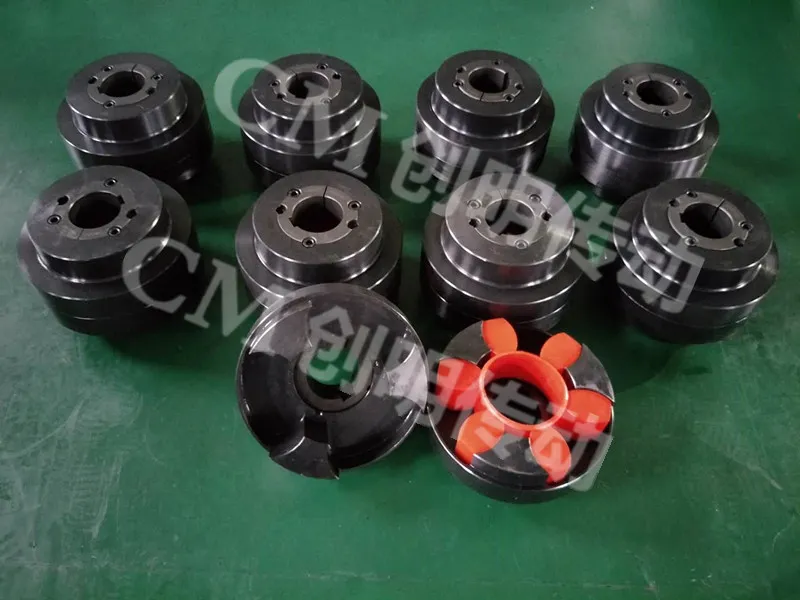
Pin-and-bush flexible couplings address a key drawback of jaw couplings: jaw couplings require dismounting one coupling half to replace the elastic insert. While double-flange jaw couplings allow insert replacement without moving the coupling half, their complex construction adds mass and rotational inertia, limiting application scenarios. For the same transmitted torque, pin-and-bush flexible couplings feature a much smaller radial dimension, lighter weight and lower rotational inertia. To suppress vibration and absorb peak shock loads in mechanical transmission systems, flexible couplings are engineered with damping and cushioning properties.
The pin-and-bush flexible coupling boasts a simple structure, enabling convenient assembly, disassembly and elastic element replacement without shifting either coupling half. Its elastic inserts are commonly made of nylon, offering minor compensation for shaft misalignment. It is not recommended for low-speed, heavy-duty drive systems or applications subject to severe shock and vibration. Its strength design verifies the shear strength of the elastic pin cross-section and the bearing strength between pins and pin holes. This coupling transmits torque via pins fitted with elastic sleeves, which insert into flange holes on both coupling halves.
Beam flexible couplings feature a continuous multi-turn helical cut, delivering excellent flexibility and low bearing loads. They accommodate angular and axial misalignment well, yet perform poorly with parallel offset. Bending of the helical slot in two directions simultaneously creates substantial internal stress, leading to premature coupling failure. Although the long helical-slot design flexes readily under misalignment, torsional stiffness also varies significantly under torque load.
When the motor shaft features a D-shaped profile and set screws fail to secure the connection reliably, the bore of the flexible coupling can be machined into a matching D-bore sized for the motor shaft. Combined with set screw fastening, this design effectively prevents slipping.
Tightening the four set screws on the end face of the flexible coupling generates clamping force on the locking bushing for expansion fastening. This method suits high-torque stepper and servo motor connections, including locking-bush diaphragm couplings, locking-bush jaw couplings and locking-bush flexible couplings.
Pin-and-bush flexible couplings address a key drawback of jaw couplings: jaw couplings require dismounting one coupling half to replace the elastic insert. While double-flange jaw couplings allow insert replacement without moving the coupling half, their complex construction adds mass and rotational inertia, limiting application scenarios. For the same transmitted torque, pin-and-bush flexible couplings feature a much smaller radial dimension, lighter weight and lower rotational inertia. To suppress vibration and absorb peak shock loads in mechanical transmission systems, flexible couplings are engineered with damping and cushioning properties.
The pin-and-bush flexible coupling boasts a simple structure, enabling convenient assembly, disassembly and elastic element replacement without shifting either coupling half. Its elastic inserts are commonly made of nylon, offering minor compensation for shaft misalignment. It is not recommended for low-speed, heavy-duty drive systems or applications subject to severe shock and vibration. Its strength design verifies the shear strength of the elastic pin cross-section and the bearing strength between pins and pin holes. This coupling transmits torque via pins fitted with elastic sleeves, which insert into flange holes on both coupling halves.
Beam flexible couplings feature a continuous multi-turn helical cut, delivering excellent flexibility and low bearing loads. They accommodate angular and axial misalignment well, yet perform poorly with parallel offset. Bending of the helical slot in two directions simultaneously creates substantial internal stress, leading to premature coupling failure. Although the long helical-slot design flexes readily under misalignment, torsional stiffness also varies significantly under torque load.
Previous: No more data